Questions from Parents

This page was spawned in response to great questions and conversations with community members, and in recognition that these themes are consistent or applicable to all parents, and that it allows us a starting point to continue the conversation.

Go Straight to Yours

  1. What will you bring to the school board?
  2. How will you work with people who disagree with you?
  3. How will you improve the experience and opportunities for our current and future students?
  4. What solutions do you have?
  5. How are you involved with Special Education?
  6. Are you involved in any other community events for this election?
  7. Safety, discipline, and bullying: how will you keep my kid safe at school?
  8. Technology, AI, and screen time: what should I expect for my kid?
  9. How do I reach you, and what happens when I do?
  10. Will you, Jill, and Claire vote as a bloc?
  11. Will my kid be welcomed here?
  12. Where do you stand on vouchers and school choice?
  13. What is the primary job of a school board member?
  14. What are the core responsibilities of this office?
  15. What matters most in an elected official?
  16. Who are your constituents?
  17. What is your ideal learning environment for students?
  18. What legacy would you like to leave?
  19. Student representative at the board table
  20. What does "every family" look like when you disagree?

Every answer on this page is in my words. If yours isn't here, ask it; I read everything that comes in.

What will you bring to the school board?

Short answer: A listening ear, a long-term stake, the habit of doing the work, and 15+ years of making sure the numbers are right.

I bring a listening ear, first and most. I am eager for you to have this experience first-hand.

I bring a long-term stake. My kids are in 4th and 2nd grade this year, and both have attended Forest Lake Area Schools since before Pre-K; they were heavily involved in ECFE thanks to my wife Jenny. My kids have told me they want to stay in this district. I am leaning into that, and bringing the full weight of my experience and education to bear in a way that can support better outcomes for all kids. I will earn your trust. You will never have to wonder whether you should have voted for me; the track record I establish will answer that for you.

I lean into doing the work. I sit on the district's Policy Advisory and Curriculum Committees, I served on the Lino Lakes Elementary principal selection committee, I attend community events, I've built relationships with building and district administrators, and I throw as much support as I can behind the great teachers who are doing the education work. I had a full calendar year to think about running before the time came; I used it to get to know the people doing the work across the district.

Professionally, I have 15+ years in finance and financial operations, building and running the systems that make sure the numbers are right. Today I'm a Senior Principal Data Engineer in the finance organization of a Fortune 5 company; I'm one of three engineers who build and run a multi-million-dollar platform the business depends on to get its numbers right. Accuracy and getting-it-right are the daily discipline; a wrong number costs real money and there is no room to be wrong.

I have a propensity toward learning and an ability to assimilate information quickly. I research, I generate data or insights (formal or informal), I share what I learn with the people impacted, and we convene about the real implications of the question "as it stands." I use knowledge to advise my decision-making, and I encourage others to seek understanding and let facts and data inform theirs. Knowledge was made to be shared; my role is to unlock tacit knowledge and make it explicit, durable, and permanent.

I will bring families with me into every meeting. "How does it end?" and "Is this good for families?" are my guiding principles; questions that can be applied across the board as a litmus test for whether something will be well-received, is not a good idea, or needs enhanced communication in order to be understood well in the community.

Integrity and authenticity: you will not need to question what I'm thinking, and it will be directly reflective of the parent and community voice. I'm not afraid to learn, to do deep research, to check work, to have my work checked, to grow, and to share knowledge. These are the hallmarks of a leader who asks people to come along on a collaborative journey; not one who steamrolls through a political process to achieve an agenda.

What that looks like on the board

Plan before the crisis

"You should never hear about a problem for the first time at the meeting where we vote on it."

On the board: budgeting discipline built in a stable year; boundary changes with families in the room while options are weighed; no seven-hour meetings at 2 a.m.

Memory that outlives people

"If I can't show you why we decided something, we didn't decide it well."

On the board: decisions come with a written rationale, and the next board can find it.

Name the real question first

"We agree on what the problem is before we argue about the fix."

On the board: get to the root of the "disagreement," which may not be one.

Reduce load with technology

"More of a teacher's day on kids; less of it on forms."

On the board: process consultation across the district to take paperwork off staff.

Verify every dollar

"Every dollar has a reason you can see."

On the board: "trust but verify"; every line answers "what does this buy for students?"

Bridge board, admin, teacher, parent

"If a policy can't be explained to a parent in two minutes, it isn't ready."

On the board: policy explained in plain language before it lands in a classroom.

Train, don't mandate

"New things come with training and a way to say 'this isn't working.'"

On the board: nothing new arrives without training and a feedback loop.

Pilot, checkpoint, scale

"We try it, we measure it, then we decide; not the other way around."

On the board: changes get tried and measured before they are imposed district-wide; a migration plan before a policy flips.

Arts from the inside

"I mixed the show and taught the kid running the board; the arts aren't an extra to me."

On the board: music and the arts protected by someone who lived them, not as an extracurricular line item.

Here for the duration

"My kids will still be in these schools long after this election; I'm not going anywhere."

On the board: a long-term stake in how this district turns out.

Back to the questions

How will you work with people who disagree with you?

I listen. I've been getting a lot of practice, and door knocking has been very enjoyable. My first task is to get to the root of the "disagreement" (which may not even be a disagreement in reality) as it's perceived in that moment, so that it can be named and agreed upon. Then I use engaging conversation and ask questions to gain understanding. I learned a few years ago that listening and leading with curiosity and intention go a long way in understanding someone.

Then we have to weigh how that input jibes with present-day students and schools; whether the disagreement is rooted in a current ISD 831 concern or whether it is ideological in nature. If we can then begin solving for an issue or change that we face in Forest Lake, I gather information throughout the conversation. Sometimes topics need some research. My years of business experience taught me to close the loop on open items.

When the disagreement is with teachers or staff: when teachers react to a discussion, additional pause is warranted. They have a really good base of experience and context by which they form their opinions. If there is a belief or a known implication to impacting the student experience, the brakes should be applied; temporarily, constructively. For decisions that are pressing, being dynamic is important, but getting it right is more important. Decisions like that should start with the people doing the work, not end with them finding out from a policy vote.

On the board itself: I'll work with every member, through the chair and the superintendent, with no interest in relitigating the last two years. The fix isn't people who agree on everything; it's a majority that agrees the board should work. We will not be impassably hung on a 15% issue.

And when it's time to vote: once I feel I have a full understanding, because the levels of collaboration have been met or exceeded and we have received all the input that can be considered relevant, it is incumbent upon me to make a decision and vote accordingly. Nothing, religious views included, prevents me from getting to a yes or a no.

Back to the questions

How will you improve the experience and opportunities for our current and future students?

Short answer: Lean the board into community, connect our schools to each other, give students low-cost ways to explore what's next and real experience before they graduate, protect music, and measure what we try.

Start where the kids are: elementary schools leaning into community. PTA and PTO participation, absolutely, but let's think bigger. I've heard how supportive the board collectively used to be: polar plunges, showing up at fundraisers, generating ideas and helping implement them. I believe the board can operate from a place of "come along leadership"; our participation sets the tone for district leadership to signal to the whole school community. I see an opportunity to collaborate with local businesses on ideas like a "School Betterment Day," where local contractors, donations, and community members come together to achieve an end goal. It could be classical, like finding a way to save money building a playground the way we used to as a community; this was part of my platform before Scandia and Columbus executed exactly that this summer, and they set the precedent for how it can be done. Or, for a place like Lino or Linwood with significant outdoor footprints, a Trail Maintenance Day where community experts lead the improvement under careful controls and guidance. It's all achievable; we just have to have the collective willpower to exercise creativity collaboratively.

Cross-pollination between our schools, and a unified student experience. Our buildings are full of learning acceleration and innovation that never leaves the building it started in. Cross-pollination between schools on learning acceleration and innovation, on information and knowledge sharing, and on consulting across the system. Scaffold that with an undertaking that unifies the student experience across grade levels at different buildings, and it becomes something bigger than any one school: a district identity. I support it fully.

Curated micro-learning for exploring what's next. I'd like to see kids introduced to structured micro-learning earlier; the shape of it gets worked out with the committees and the curriculum director, but here is the idea. Example: we offer an agriculture class over a semester. A student isn't sure if it interests them and isn't sure how to research it; we offer them introductory topical videos or a blog about what the course is about, with citations and links for deeper learning, before they decide to spend credit hours on it. Smaller, faster micro-curriculums catered to a topic at a certain precision (say Trades → Auto Mechanic): vetted, researched, potentially multi-media, delivered to the student so they can explore. Low/no cost, low commitment, never required. This is the unifier: curated knowledge delivered to students, timely and intentionally. These are the decisions they will have to make about their own development after leaving our system; we should give them the research methods now. Where it goes from there: the same curated approach becomes the front door to the experience-augmentation work below, so a student can explore a field in an afternoon, try it for real in a semester, and graduate with documented hours in it; and every step is measured, so we know what worked. That is the launching point.

Experience augmentation in high school, through community and business partnership. Not another PSEO, and not a PSEO alternative; a practicum-like experience where students get to conduct the work of the discipline they are exploring, or approximate it as closely as possible. This could be observational in a setting like healthcare delivery, more hands-on in a trade or in computer work, or a hybrid in the case of a small business. With any technology-aware and self-aware district, the opportunity is here to introduce advanced entrepreneurship, at a college-like level, in high school. This is another area where community creativity and inputs could be prioritized; the main point is still to do as much as we can with as little as is required, not to increase spend.

Polymathic education: teach the layers. The notion that "digital" and "mechanical" are separate silos, and that you can make a career out of one versus the other, is antiquated. We have to teach layered thinking; the ability to move in and out of digital and non-digital spaces. Protect the STEM and Trade pathways, de-silo them, and enhance current offerings with robust program supports before and after. Not for the prestige of an academic program, but to make kids who are highly self-sufficient problem-solvers. Parents have been saying a version of this for years, in a lot of different words: kids need to be resilient. I think the need underneath it is simpler. We give kids the quiet confidence that their effort is what moves things, so that when help does arrive it is a gift and not an expectation. Call it the shift from expectation to effort.

Protect and grow music, at every level. Continued protection for music programming across all levels, namely through protection of funds and opportunity, and an increase in engagement with music in the broader community. In addition, enhancing "advanced opportunities" in the music arts at the high school strategically, through the right partnerships. I come at this as a musician who has played for thousands of people across festivals, churches, bars, and band tournaments, and who got into recording and production in the years right after high school. Those experiences were transformational for me, and at the time they were basically relegated to college-level training. This is one area we can both protect and enhance. We keep and protect the music structures in place today, which are critical to how a good many kids unlock creativity and find a deeper sense of identity and belonging; and I believe our exceptional music programs can be given additional tooling that unlocks another distinction for Forest Lake.

Technology is a tool, not a lifestyle, while also chasing leadership in technology capabilities at the high school level. The full treatment is in Question 8.

Data-driven decision-making. I'll push for the district to lead in gathering meaningful longitudinal data in support of the programs and approaches we take: implementations and programming designed around the need to prove whether a program has been effective, using just-in-time data points gathered from student surveys, teacher surveys, competency measures at strategic points in time, and aggregation and reporting that shows the effect of the choices that were made. Prove the results and make them available more broadly as proof of success. Use the data to celebrate victories, make adjustments where things are less effective than expected, or end something that simply isn't being proven to work.

Back to the questions

What solutions do you have?

Short answer: Real experience for students, community input before decisions instead of after, an open door, time in every building, and a budget where every line answers "what does this buy for students?"

Relationships that produce opportunities. I'll work to find relationships that can produce opportunities for our students: apprenticeship-like trainings, group trainings, tours, curated experiences with industries relevant to what is immediately in front of them after high school. My part is opening the door: meeting people, asking the questions, and handing the relationship to the people whose job it is to run the program. For a student going into a trade, being able to say "[n] hours of experience with [X]" means they now have a resume, not just a transcript. Our ability to put together a complete solution to something like this has never been simpler than it is today. Let's get it done. We can take this approach across almost all disciplines and domains to improve the readiness of students for the paths they are interested in and can reasonably pursue, using district levers that give students these opportunities. When this is achieved, a student will have actionable experience on paper, in voice, and in practice; the ability to "prove it."

Community input, done properly, and earlier. Eliciting the community voice has never been simpler than it is today; we are under-shooting our own capabilities. The board needs to provide ample announcement of discussion; not presented, then changed, then re-scheduled, then an agenda change, and still no decision. I'd like to see earlier communications (possibly a call to action) on issues that may impact a student or family, and then the board actually making use of that data; it's actionable insight for the superintendent too. Open office hours for staff and families, at times that work around actual shift schedules, is where I want this to go. The things that happened over the past calendar year happened because the community voice was not solicited, and the decisions being made were not reflective of community preferences. I will not tolerate this; I'll vote no on any item that reaches the board without the community engagement it needed.

An open door, already open. I have already opened my door to, and responded to, parents who have contacted me. I expect to hear from more parents after this page is live, and I am here. I am not a member of the board yet, and I will not pretend to be or masquerade as one. I am a citizen now; I should hear from citizens and parents about their concerns, and I may someday be able to bring those to the table.

Be in the buildings. Regular building visits across all sites, with the superintendent's knowledge and on each building's terms, not just the ones nearest me; 220 square miles means the far edges get forgotten if you don't plan against it. I helped Scandia Elementary with their playground build this summer specifically to get a feel for that parent/staff/building. Several building administrators, including at the high school, have already said yes to "can I come volunteer for a day." Informed is the goal. Interfering is not.

Reduce load with technology. I'll ask the superintendent for an operational-load review: where technology can take work off staff across the system, and what that is worth in hours. Then it goes on the board's reporting cadence, so we can see whether it moved. In parent terms: less staff time on paperwork, more on kids.

Fiscal transparency and responsibility. "Trust but verify," and the first question on every line: what does this buy for students? Programs should be able to show their impact, or make an honest case for why the data isn't there yet. Silence is the only unacceptable answer. Build the budgeting discipline during a stable year, not in a crisis; a nearby district rolled zero-based budgeting out mid-deficit and it became something staff feared rather than a discipline. I have done research on zero-based budgeting for anyone interested in learning more; let me know through Facebook, by email at andiforschoolboard@gmail.com, or through the contact form on this site if that interests you.

Ask for the data that anecdotes point at. Sub fill rates, vacancy days, incident reports, turnover by building. When staff tell me something is happening, the numbers either confirm it or tell me where to look next. You cannot fix something that has not been named, or at least alluded to, as "broken" or "lacking."

Back to the questions

How are you involved with Special Education? Are you an avid listener in their meetings? Do you know the policies, statutes, budget, and where the money goes?

Short answer: I'm not a special-education parent and I'm not an expert; I'm learning it in the open, with the people who do the work, and I'll protect the staffing and funding that SpEd quality depends on.

I'll be straight about where I am. I am not a special-education parent, and I do not take my familiarity through friendships with teachers and paras for granted; it is incumbent on me to learn and be able to function clearly in this space. I met the President of FLAEP, the association that represents our paraprofessionals, behavior intervention specialists, and health office staff, about three weeks ago, and she has given me things to attend, consider, and listen in on in the near future to further acclimate myself to the special-education space specifically.

Some things I'm looking at right now, brought forward by a community member: Minnesota Statutes section 120B.122 (the dyslexia specialist requirement) and chapter 125A (special-education programming and oversight, and its implications); technology access for students in need, where the case example was dyslexic learners; and the special-education reading curriculum standards. I'm also doing informational learning on the Orton-Gillingham approach and how it is used today; several of its core tenets are embedded at the elementary level, and I know less about the specific special-education implications. I've gone through 125A and 120B and I'll keep reading. This is ongoing learning. I am no expert, and I don't think this seat needs an expert; it needs a listener with a high aptitude for learning and knowledge assimilation, and I'm willing to say that openly.

For the community: the district's Special Education Advisory Council (SEAC) is hosting a Family Education Night on Special Education IEP Basics, with guest speakers from the PACER Center, on Monday, September 14, 2026, 6:00 to 7:30 PM, in the Forest Lake High School Media Center. Topics include how to read and understand your child's IEP, parent rights in the special-education process, and the supports and resources available to students and families. I'll be there to listen, and I'd love to talk with any and all of you who want to, there.
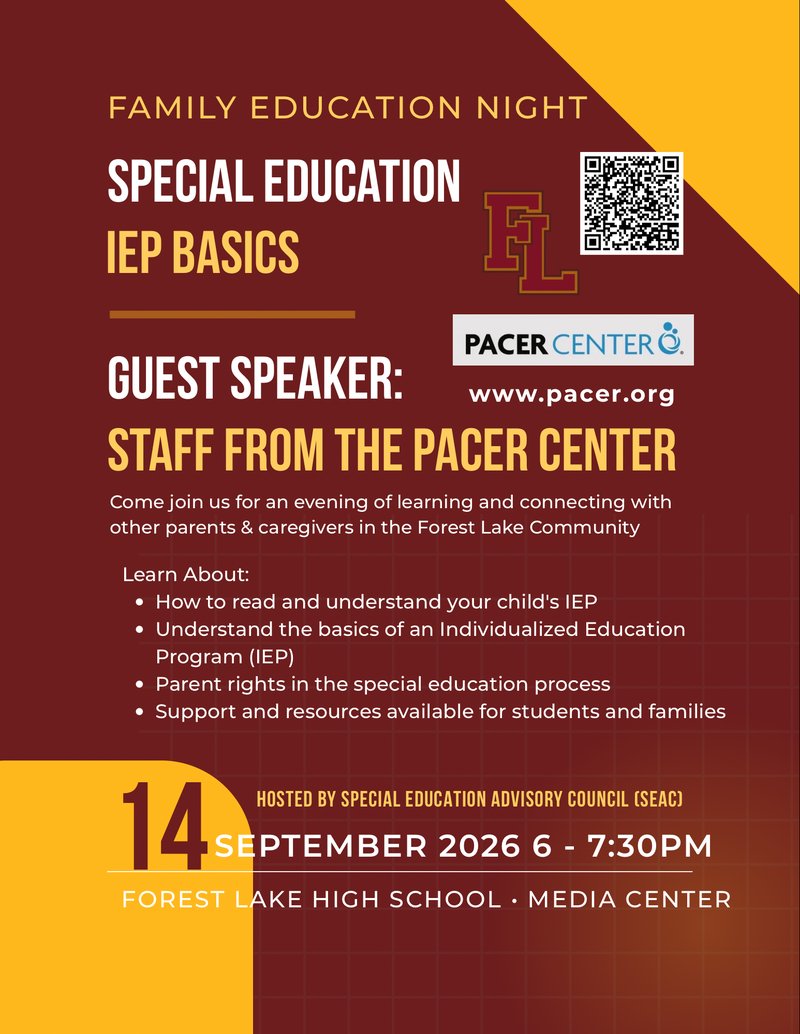
SEAC Family Education Night flyer: Special Education IEP Basics with guest speakers from the PACER Center, Monday, September 14, 2026, 6:00 to 7:30 PM, Forest Lake High School Media Center.
SEAC Family Education Night, September 14, 2026. Flyer from the district's Special Education Advisory Council.

On the money: Special Education is this district's single largest program category at $3,192 per student; federal dollars cover $236 of it. The other 92% is carried by state and local funds, and Minnesota's statewide cross-subsidy has grown from $1.8B to $2.7B in five years, with a $250M cut trigger now live at the legislature. Federal Medicaid cost-shifting puts school nurse, OT, PT, and speech reimbursements at further risk. I won't pretend a board member controls Congress or St. Paul; what a board controls is how it plans and what it protects. That means budgeting for the cross-subsidy as a known structural fact rather than an annual surprise, and treating mandated services as last in line for cuts when uncertainty hits, not first.

It also means protecting the people who deliver those services; SpEd quality is staffing. Paras, behavior intervention specialists, and health office staff are losing to retail and clinics on pay and hours right now. What I'll push for is concrete, inside a budget that can carry it: wage floors benchmarked to the local labor market, benefit-eligible hours, paid training before day one, safety reporting that produces visible follow-through, and time-to-fill and vacancy data reported to the board on a cadence.

I'm endorsed by FLEA, the teachers' association, and by FLAEP, the association that represents the paraprofessionals, behavior intervention specialists, and health office staff who do this work every day. I am right with and behind all of these professionals.

Back to the questions

Are you involved in any other community events for this election?

We have already done several parades, all of the Arts in the Park events, a Meet and Greet at the Forest Lake YMCA, and weekly literature distribution. We have more coming, and we are adding two more Community Conversation meetings in the near future; dates coming soon. The best way to find these is to follow one of our pages, though I will also post them here.

Upcoming

  • Monday, September 14, 2026, 6:00 to 7:30 PM. SEAC Family Education Night: Special Education IEP Basics, Forest Lake High School Media Center. I'll be there to listen. Flyer · Add to calendar · Google Calendar
  • Community Conversation #1. Date TBD.
  • Community Conversation #2. Date TBD.

Follow along: Facebook, Andi For FLAS - ISD 831 - 2026 · Instagram, @andiforflas

Back to the questions

Safety, discipline, and bullying: how will you keep my kid safe at school?

ISD 831 already had the right answer in its own policy and history. Explicit bans on hate symbols were added after a documented 1997 racial assault on school grounds, and our superintendent and high school principal both said to keep them. The board changed the policy anyway. What has kept those protections usefully in effect since then is building leadership, not the board; and nobody explained to families what had actually changed until after the community had already reacted. The problem was not only the decision; it was that the communication never articulated what actually changed. Decisions like that should start with the people doing the work, not end with them finding out from a policy vote.

The same principle applies to student-led spaces. Clubs like Open Minds serve LGBTQ+ students and students with IEPs and disabilities alike, and the research links them to better attendance, mental health, and academic outcomes. I have personally observed it: these are safe places where kids have a more "open arms" view of others, and they carry that into spaces that aren't a club event; they welcome and include people immediately. I've witnessed this multiple times, first-hand, this past school year; we could all learn something from those kids, and I did. The club restructure went through. Reputational damage was done by how it was approached; at the end of it, the students are still protected. In future, I'll work to protect student-led club access at every grade level and, where possible, enhance its accessibility and appeal.

Staff safety is student safety. For behavior intervention specialists and paras especially, injury and assault reporting has to produce visible follow-through. If reporting changes nothing, people stop reporting, and then they leave. This population of educators is one of the most engaged groups; they are also the one at most significant personal risk during their daily work, and we must acknowledge that reality with protections that address the root problems.

On anything that touches protected community history or identity, the board's job is to listen to the superintendent, staff, and community before acting; not after a walkout or a packed meeting forces a retreat.

On bullying, discipline, and building security specifically: I'm not going to hand you a policy I haven't earned yet. I am interested, and I am pursuing lines of questioning through the proper channels that enhance my understanding; when I can say more, I will say it here.

Back to the questions

Technology, AI, and screen time: what should I expect for my kid?

Short answer: Technology is a tool, not a lifestyle; and has to be balanced with engagement in the natural world in order to produce well-rounded, highly-capable, and high-confidence kids. Less screen time where possible in favor of optimizing technology use for productivity and learning.

Technology is a tool, not a lifestyle. Not every answer comes from a screen; nature and its residents have always been the most organically effective tool for resetting an overwhelmed mind. Forest Lake schools need intentional, structured opportunities for students to learn through direct interaction with the natural world; not as a break from academics, but as its own distinct way to grow.

On screens: screens and computers can be over-leveraged in learning at times, and our goal would be to optimize for less where possible. Individual schools, leaders, and teachers, I believe, are already doing this as best they can within the confines of what must be taught. I am very interested in two things: whether there is a system-level opportunity that isn't being leveraged to reduce screen time, and how we use the technology to accomplish learning goals and what structure and framework is behind it.

On AI specifically: this is not something in flight. I was asked what I can bring to the district; this is an example of what I think about and then begin to work through. What follows is a potential direction for the district; if it's attractive to you, it's something you opt into by voting for me. My stance is human-centered, educator-modeled learning augmentation. I am not advocating for putting AI into the curriculum; I'm targeting a strategic integration for 9th grade and up, with usage backed by intentionality and purpose. It has a training component, a train-the-trainer component, a longitudinal data-gathering phase for measuring whether it's working, a parent supplement and resources, and protections. Protections include, but are not limited to: internet safety, AI safety, training against cognitive offloading, an environment that is secure and has limits on what it will do and deliver, ethical and responsible use, and anything else the committee and the curriculum team decide is needed. I've raised this with district leadership as a parent and a citizen. If it ever moves, it moves the way anything should: through the curriculum team, the committees, and a board vote, with the protections above in place first.

Why now: the state of Minnesota and the country as a whole have done little to nothing in this space. There is work to be done here, and it is not being done; I would rather Forest Lake set the standard than inherit someone else's. I am interested in broader conversations with community expertise on large and small language models in the learning space, and in seeing this district lead the state in innovative approaches to technology education, technology in learning environments, and technology as instruction extension. Not for prestige; to make kids who are highly self-sufficient problem-solvers.

Back to the questions

How do I reach you, and what happens when I do?

Email me at andiforschoolboard@gmail.com or use the form on this site. I have already opened my door to, and responded to, parents who have contacted me. I am a citizen now, not a board member; I should hear from citizens and parents about their concerns, and I may someday be able to bring those to the table. My years of business experience taught me to close the loop on open items; if I don't have the answer, I'll tell you that, go find it, and come back.

Back to the questions

Will you, Jill, and Claire vote as a bloc?

Not by default or "by design." A voting bloc forms around a political agenda and governs in service of it; that is precisely what broke this board. What Jill, Claire, and I share is a governance philosophy: process integrity, non-partisanship, student-first decisions. We will disagree with each other; we do, and we have, and we are adults capable of working through it collaboratively. Each of us will vote independently; nobody is whipping anybody's vote.

As for the existing members: I'll work with every one of them, through the chair and the superintendent, with no interest in relitigating the last two years. I have had individual, detailed conversations with every member of the current board to get to know them, and I am ready to go to work with the two members who remain for the coming two years of their terms, not only with the two people I'm running alongside. This board deadlocked four times on a single vacancy and sat through a seven-hour meeting that ended at 2 a.m. without paying the district's bills. The fix isn't three people who agree on everything; it's a majority that agrees the board should work. You can see exactly who we are, who we're running with, and why. That is what transparency looks like; you will get it from me every time.

Back to the questions

Will my kid be welcomed here?

I said this on the record at a board meeting last summer, and I'll say it again: I love this district, and what makes it isn't the operations; it's the people. The welcoming, high-quality, genuinely inclusive culture I experienced as an ECFE parent is rare at this scale. As more families with different backgrounds, languages, and life experiences choose ISD 831, the district's job is to make sure that welcome reaches them just as fully; through how we communicate, how we staff family-facing roles, and how visible different communities are in our schools' day-to-day life. Throughout the few years my kids have attended Lino Lakes Elementary, I've heard repeatedly, from them, about a new student they are excited to meet and bring into their class. Kids who arrive mid-stream are welcomed quickly by teachers and peers alike. The board's role is to set that expectation from the top, not assume it happens on its own.

Back to the questions

Where do you stand on vouchers and school choice?

My focus is on making sure ISD 831 is the school of choice for families in our area, through the quality of our programs, like the STEM focus at Lino Lakes Elementary, the Spanish Immersion program at Forest View Elementary, or the International Baccalaureate program at Scandia Elementary; not through policy that diverts public dollars to private schools. ISD 831 already spends about $1,365 less per student than the Minnesota average, and enrollment is down 16% since 2010-11. Choice within the public system, open enrollment and specialty programs, is part of how ISD 831 already competes, and that's where my focus is. I would need very compelling evidence that I have not yet seen to move me toward vouchers in our district; I am stalwart against pulling public school funding apart through targeted voucher programs.

Back to the questions

What is the primary job of a school board member, in your view?

Protect the culture that makes this district work, and get out of its way. The people in these buildings are the reason ISD 831 is good; the board's job is to give them a stable budget, clear policy, a superintendent it trusts, and a decision process that doesn't blindside them. My test for every item is two questions: how does it end, and is this good for families? If a policy can't be explained to a parent in two minutes, it isn't ready. The board governs; the superintendent runs the district; the teachers teach. When those lines blur, kids pay for it.

Back to the questions

What are the core responsibilities of someone elected to this office?

Three things. Govern, don't manage: set policy, approve the budget, hire and evaluate the superintendent, and hold the line between the board's job and the administration's. Be accountable in public: decisions announced early, kept on the agenda, decided, and explained in plain language, with a written rationale the next board can find. And represent, which means going and getting the community's voice before the vote rather than waiting for it to show up as a walkout. A board that does those three things is boring in the best way; everything else the district does depends on it.

Back to the questions

What characteristics or principles matter most in an elected official?

Integrity and authenticity first: you should never have to wonder what I'm thinking, and what I'm thinking should reflect the people I represent. Then the habit of listening before deciding; getting to the root of a disagreement, which often isn't one. Then coachability. I've been wrong in public before and fixed it in public; a leader who can't be told "that isn't working" isn't leading, he's steamrolling. And finally the willingness to decide. Once the collaboration thresholds are met and the input is in, it is incumbent on me to vote yes or no. Elected officials who can't get to a vote aren't representing anyone.

Back to the questions

Who are your constituents?

Every resident of ISD 831, across 220 square miles and three counties, whether or not they have a child in the schools. That includes the taxpayer who never sets foot in a building and the family that just enrolled. It includes the 1,200-plus people who work here, because a district can't serve students well while it burns through staff. And it includes the roughly 6,000 students who don't get a vote, which is exactly why they need one at the table. I'm not there for a party or an interest group; I said so on day one and I'll keep saying it.

Back to the questions

Describe your ideal learning environment for students.

One where a kid walks in wanting to be there. That means the academic, social, and emotional pieces are woven together on purpose, the way this district already does it, not bolted on as separate programs. It means safe places to belong, including student-led ones. It means teachers with the pay, the staffing, and the trust to run the model at full capacity. And it means learning that moves between the digital and the physical, so a graduate can troubleshoot a machine and a spreadsheet, and leaves with documented hours in something real. Add time outside; not every answer comes from a screen.

Back to the questions

What legacy would you like to leave?

A board nobody has to think about. Meetings that end at a reasonable hour with decisions made, a budget where every dollar has a reason you can see, and a community that finds out what's changing before it changes. If a parent five years from now can't remember the last time the board made the news, and the teachers who were here in 2025 are still here, I did the job. I have a few other legacy points that I'd like to do including exploring enriching "college-like" academic and apprenticeship experiences in high school, increasing learning velocities through guided learning, as well as ongoing protection of music and arts programming.

Back to the questions

You've talked about exploring a student representative at the board table. What would that look like?

Short answer: Two non-voting student representatives, chosen by students, in a mentorship with the board. It's a starting point for students, staff, and families to shape, not something one board member adopts.

For a brand-new idea, I wanted to see people's first reactions before putting a structure on it. Draft-then-feedback makes sense when you're changing an existing policy. Here the reactions were open, curious, and optimistic, so here's a first draft, a v1, with the doors wide open to change.

Purpose: A mentor/mentee relationship between the Board and student representatives. The goal is an enriching experience that gives students exposure to how governance works, including what it means to represent a group rather than just yourself.

Objectives: Student representation at board and committee meetings. A two-way link to the student body, so knowledge and insight flow in both directions. One more channel for the student voice to reach the board.

Student role: Non-voting, ex officio, similar to Hopkins and Minneapolis. Full participation in public discussion; not included in closed sessions.

Seats: Two students, one each from 10th and 11th grade. One term each if interest is high, so more students get the experience, with the option to serve again if the need is there and the students want that.

Selection: Student-led, likely through an open nomination process or as part of an existing student body election. Any student can run. Student council certifies the results. The Board plays no role in choosing.

Commitment: Meetings are after school and after business hours, so the commitment is similar to other extracurriculars like sports or marching band.

I led with "explore" because the timing questions need more work: how selection lines up with the board calendar and the start of the school year, term length, training and onboarding, single or repeat terms, and warm hand-offs from one student rep to the next.

If elected, I would bring this to the board as a proposal, a starting point for students, staff, and families to shape the details before anything is drafted as policy. No single board member gets to adopt any of this. We'd also report back on how it's working, including from the students themselves.

This idea came out of a community conversation, and that conversation already made it better.

Sources:

Back to the questions

Everyone says they'll represent every family. What does that look like when a student or family wants something you personally disagree with?

Short answer: My personal views are mine; the seat isn't. I'll hear students before votes that affect them, hold every student club to the same rules, keep every parent's right to review what their own child learns, and explain my votes in writing, especially the ones someone won't like.

"All families" is easy to say. A parent asked me what it looks like in practice, including the part where I disagree. Here it is.

Listening to students. Students should hear about decisions that affect them before the vote, not after a walkout. The student representative seats in Question 19 are one channel. Showing up to student-led events, with the superintendent's knowledge and on the building's terms, is another. When a policy touches students directly, I'll ask that student input be on the record before it comes to a vote.

Clubs, on equal terms. Federal law already sets the fairness standard. Under the Equal Access Act, if a high school lets any student-led, non-curricular club meet, it has to give every such club the same access, regardless of the religious, political, or philosophical content of what its members say. That protects Open Minds and a faith-based student club the same way. That's the standard I'll hold to, and I won't treat a club differently because of what its members believe, or what I believe.

Parents who see it differently than I do. Families with traditional values are my constituents as much as anyone. Minnesota law gives every parent the right to review instructional materials and arrange reasonable alternatives for their own child. I'll make sure that process is easy to find and actually works. What I won't support is one family's objection deciding what every other family's child can access.

It's 2026, and the technology is ready to make this information easier to get than it has ever been. I'll push for what I call Show Your Work: one place for parents, built on the tools families already use, where information is easier to find than it is today, with the resources in one place: the handouts that come home from school, the parent guide that should come with any new curriculum (a parent handout for AI instruction, for example), and more. It should also hold the record behind each decision: what was decided, when, what input the board heard, and why. We ask students to show their work; the district should do the same. For a parent who sees it differently, the first answer is being able to see how we got to where we are, with the justification written down. That doesn't guarantee agreement; it does mean nobody has to guess. Read the full Show Your Work proposal.

When I disagree. I'll tell you where I stand, and then I apply the same test to every item: is this about a real need for ISD 831 students today, or is it an ideological fight imported from somewhere else? A student's safety and access to learning come before my comfort. I'll vote on the evidence, the law, and the input, and I'll put my reasoning in writing, including when you won't like the answer.

What compromise looks like. Most of what a school board decides doesn't divide anyone; a small share of issues does. On those, reasonable compromise means asking the superintendent and staff first, hearing the community before the vote, keeping the protections that are working, and explaining in plain language what changed and why. The hate-symbol policy in Question 7 is what it looks like when a board skips those steps.

If you think I've gotten one of these wrong, tell me; here's how.

Sources:

Back to the questions

Your question isn't here? Ask it. I read everything that comes in, and I'll add the ones that belong on this page.

Ask Andi